what is the income level to qualify for financial aid
Parents sometimes wonder if it's worthwhile to file the Complimentary Application for Federal Pupil Aid (FAFSA), especially if they remember their income is besides high to qualify for demand-based federal financial aid. But, at that place are no simple FAFSA income limits, or income cutoffs on financial aid eligibility, in part due to the complexity of fiscal help formulas.
Unless the parents earn more than than $350,000 a yr, have just ane kid and that child volition enroll at an in-land public college, they should still file the FAFSA form, as there is a proficient gamble they may authorize for federal student aid or country or institutional grants. They may also qualify for low-cost federal loans and federal piece of work-report.
Even if a higher uses the CSS Profile to determine institutional aid eligibility, the pupil must all the same file the FAFSA to apply for federal fiscal aid.
Use our Financial Aid Reckoner to estimate the expected family contribution (EFC) and your financial need.
Intuition is Inaccurate
Parents have a trend to underestimate eligibility for demand-based help and overestimate eligibility for merit-based assist.
Eligibility for need-based aid depends on more than than just income. Important factors include the cost of the college, the number of children enrolled in college at the same time, family unit size, special circumstances that affect the family unit'south power to pay for college and whether or not the student is a dependent pupil. Student income and avails are assessed more heavily than parent income and assets. Graduate students are eligible to borrow a larger amount of federal educatee loans than undergraduate students. Fiscal aid formulas are likewise more than focused on greenbacks flow than on income.
Academic operation is non enough to distinguish a student from his or her peers, peculiarly at the nearly selective colleges. At that place are more than than 80,000 valedictorians and salutatorians each twelvemonth. Grade aggrandizement and weighted GPAs contribute to more high school students having a 4.0 (or improve!) GPA on a 4.0 scale. Thousands of students get a perfect score on the Saturday and ACT each yr. Tens of thousands of students go at least a 1500 on the SAT and a 33 or better on the ACT.
Students must brand satisfactory academic progress to qualify for federal financial assist, but they shouldn't count on good grades to pay for college.
Apply for Financial Aid Every Twelvemonth
It is important to submit a financial aid application every twelvemonth, even if you lot did not become annihilation other than a student loan final year. There are subtle factors that can affect eligibility requirements for need-based fiscal assistance. These factors tin can change from 1 year to the side by side. Congress tinkers with the financial aid formulas periodically. If you don't file the FAFSA every twelvemonth, you might miss out on financial aid.
Fiscal assist is based on financial need, which is the difference betwixt the toll of omnipresence (COA) and the expected family contribution (EFC). Financial need increases when the COA increases and when the EFC decreases.
Thus, a student who enrolls at a higher-cost college might qualify for some financial aid, while the same student might authorize for no financial aid at a low-cost higher, such as an in-state public college.
The parent contribution part of the EFC is divided by the number of children enrolled in college at the aforementioned time. When the number of children in college increases from ane to two, information technology is almost like dividing the parent income in half, which tin qualify both children for much more financial assistance than either could qualify for on their ain.
For example, when the oldest child enrolls in college for the first time, that kid might not authorize for much college financial aid. However, when the oldest and second oldest children both enroll in higher at the same time, the number of children in college increases from one to two, potentially qualifying them for more financial aid.
Thus, there are no clear FAFSA income limits. Eligibility for need-based fiscal assistance depends on more than simply income.
See as well: Complete Guide to Financial Aid and FAFSA
Eligibility for Grants
In that location is no explicit income cutoff on eligibility for the Federal Pell Grant. Eligibility for the Federal Pell Grant is based on the expected family contribution (EFC), not income.
Based on data from the National Postsecondary Student Assist Study (NPSAS), more 94% of Federal Pell Grant recipients in 2015-16 had an adjusted gross income (AGI) under $60,000 and 99.ix% had an AGI under $100,000.
The odds of receiving a federal grant decrease with increasing income, as shown in this nautical chart.
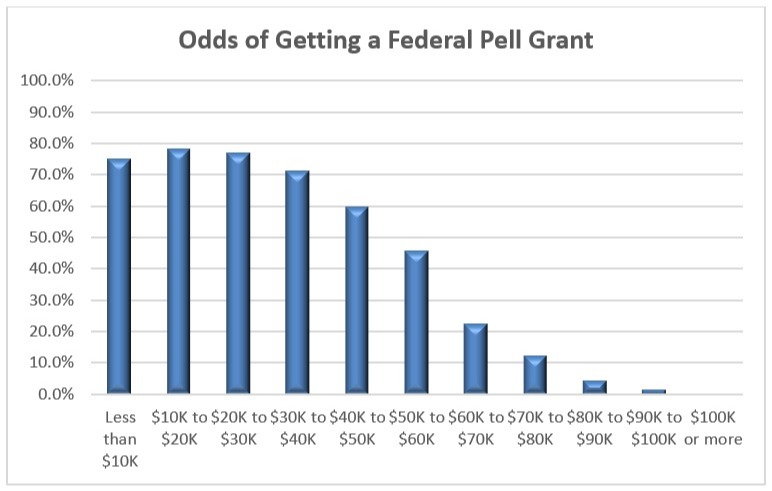
Equally noted above, a family with two or more children in higher may qualify for a Federal Pell Grant considering the parent contribution is divided past the number of children in college. Also, the family unit may have special circumstances that bear on their ability to pay for higher.
Eligible students may besides qualify for other forms of financial help, such as institutional grants. For example, some students whose parents earn $100,000 or more will qualify for grants from their college. For example, almost a tertiary (32.nine%) of students whose parents earn six-figure salaries received institutional grants. A fifth (21.four%) received merit-only grants and a tenth (11.6%) received need-based grants.
Some colleges require students who are applying only for merit help to file the FAFSA, just to make sure they go whatever demand-based assist for which they are eligible. Colleges often utilize demand-based aid to offset role of a merit-based grant or scholarship.
If at that place is any question as to whether a student might authorize for financial aid, apply the college's internet cost calculator to go an estimate as to how much gift aid the student might get.
How Many Students Pay Full Sticker Cost?
Based on 4-year college data from the Integrated Postsecondary Education Data System (IPEDS), a quarter of freshmen and a tertiary of all undergraduate students pay full sticker price. Slightly less than one-half got no institutional grants.
At Ivy League colleges, half of freshmen and all undergraduate students pay full sticker cost, and slightly more than half get no institutional grants. Generally, the percentage of undergraduate students paying full sticker price increases with greater selectivity. Simply, amongst the virtually selective colleges, fewer undergraduate students pay full sticker toll at MIT, Stanford and Princeton.
Counter-intuitively, undergraduate students at 4-twelvemonth public colleges and lower-price colleges are more likely to pay full toll than students at individual colleges. 2-fifths of undergraduate students at public colleges pay full sticker price, compared with a quarter of students at individual colleges.
Overall, a 3rd of students at 4-year colleges pay full toll, compared with almost half of students at community colleges.
The lower cost at public colleges causes fewer students to qualify for financial assistance, peculiarly among loftier-income students.
Family income affects where the students enroll.
- Students from high-income families enroll in colleges where iii-fifths of undergraduate students pay full cost
- Students from low-income families enroll in colleges where a third of undergraduate students pay full price
The same is true even when the data is limited to Bachelor's caste programs, where the proportions are one-half and a quarter, respectively.
The FAFSA is a Prerequisite for Federal Loans
Even if a student volition not authorize for grants, filing the FAFSA makes them eligible for depression-cost federal student loans, which are normally less expensive than private student loans. Fifty-fifty wealthy students will qualify for the unsubsidized Federal Direct Stafford Loan and the Federal Parent PLUS Loan. The Federal Stafford Loan is a good way for the student to have pare in the game, since they are unlikely to over-borrow with just a federal student loan.
When is it OK to Not File the FAFSA?
There are a handful of situations in which the family probably does not authorize for need-based fiscal aid, including families who:
- Tin can beget to pay for college tuition with pocket modify
- Are in the top 1 percent by income or wealth
- Who accept donated a edifice or two to the higher
Upcoming FAFSA Changes
Meaning changes are coming to FAFSA requirements, which volition bear upon financial aid eligibility for many students. These changes include eliminating the "discount" for parents with multiple students in college, and replacing the EFC with the Student Help Index. The Department of Ed will implement the changes in phase, beginning with the 2021-22 academic year, with a scheduled completion date of 2024-25.
Run into likewise: How FAFSA Simplification Volition Change Financial Aid Eligibility
If college is years away, it can exist difficult to predict how much financial aid your child will qualify for. That'southward why information technology's important to save as much equally possible in a 529 plan. Merely, if your savings come upwards brusque and you've exhausted all of your federal student loan options, you may desire to consider a individual educatee loan to comprehend the remaining costs.
Source: https://www.savingforcollege.com/article/is-there-an-income-cutoff-on-eligibility-for-financial-aid
0 Response to "what is the income level to qualify for financial aid"
Post a Comment